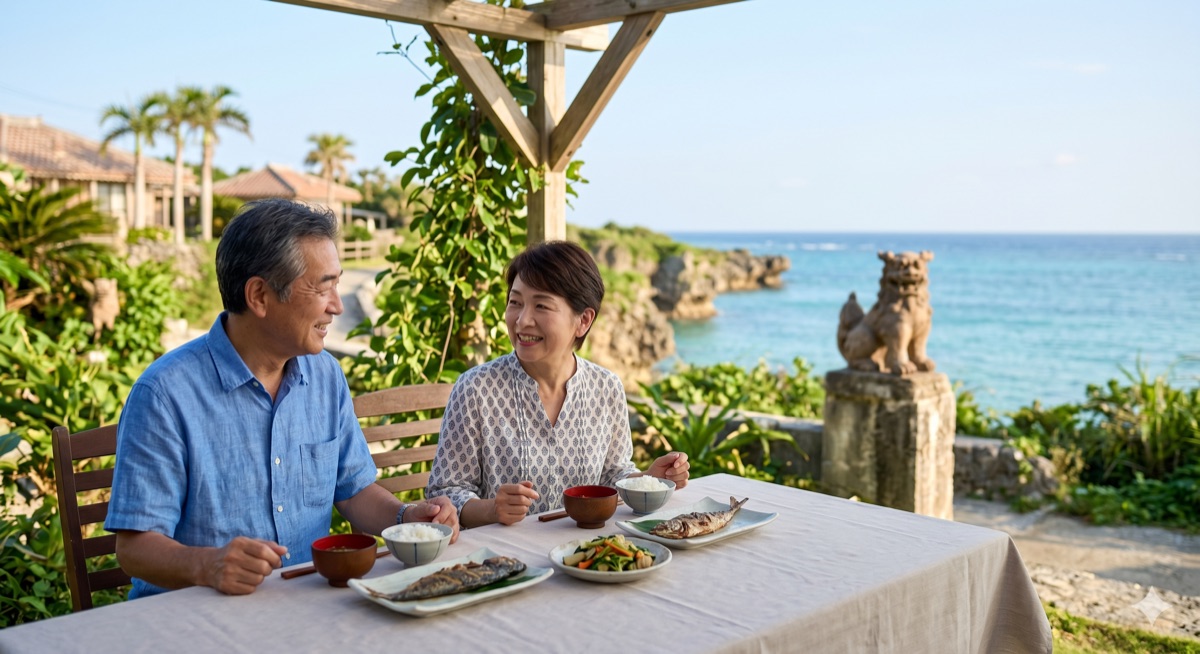
Why retirees choose Okinawa
Okinawa sits at the intersection of several things retirees look for: a warm subtropical climate, world-class healthcare, low cost of living compared to the West, genuine natural beauty, and a pace of life that genuinely feels different from a major city. It also has an unusually large English-speaking expat community by Japanese standards — partly from decades of US military presence — which smooths the cultural transition considerably.
Then there's the Blue Zone factor. Okinawa is one of only five places in the world where people consistently live past 100 in large numbers, with significantly lower rates of heart disease, cancer, and dementia than in Western countries. That's not a marketing claim — it's been studied extensively. The lifestyle factors that drive it are woven into the culture, and many retirees find themselves absorbing them naturally.
The Blue Zone: what the science actually says
Researchers studying Okinawan centenarians have identified a cluster of practices — none of them extreme — that appear to explain the longevity:
Ikigai — a reason to get up
There is no direct translation of the Okinawan concept of ikigai into English. It means roughly "the reason for which you wake up in the morning" — a sense of purpose that keeps you engaged with life. Older Okinawans don't think in terms of retirement as an endpoint. They have roles, craft, gardens, relationships, and community responsibilities well into old age. Many retirees who move to Okinawa cite adopting this mindset as one of the most transformative parts of the experience.
Moai — your social safety net
A moai is a lifelong social group — typically 5–7 people — who commit to supporting each other financially and emotionally. The tradition began as a communal savings mechanism but evolved into something more like a social contract. Members meet regularly, eat together, and look out for each other in crisis. For foreign retirees, the expat community in Okinawa often fills a similar role organically.
Hara hachi bu — stop at 80%
A Confucian saying that older Okinawans repeat before meals. In practice: eat until you are 80% full. Combined with a plant-heavy diet centred on purple sweet potato (beni-imo), goya bitter melon, tofu, and miso, this produces a caloric intake significantly below Western averages without any sense of deprivation.
Honest caveat: The Blue Zone data primarily describes the generation that grew up eating traditional Okinawan food. Younger Okinawans have shifted toward fast food and the island now has some of Japan's highest obesity rates. The longevity culture is real, but it's something you actively choose to participate in — not something that happens automatically by living here.
The visa reality
This is the most important thing to understand before planning a retirement in Okinawa: Japan has no retirement visa. There is no passive-income pathway, no "financial independence" category, and no retiree-specific immigration route. To live in Japan long-term, you need to qualify through one of the existing visa categories — most of which were designed for working-age people.
The honest framing: the earlier you start planning, the more options you have. Someone who begins working toward permanent residency at 45 while still employed has a far easier path than someone who waits until 65 and tries to engineer a visa solution from retirement.
Spouse of Japanese National
If you are married to a Japanese citizen or permanent resident, you qualify for a Spouse Visa — one of the most stable long-term statuses available. It renews in 1, 3, or 5-year increments and puts you on a clear path to permanent residency after 3 years of continuous residence.
Financial requirement: the Japanese sponsor must demonstrate household stability (typically ¥3M+/year combined income or equivalent savings).
Permanent Residency (PR)
PR gives you indefinite right to live and work in Japan with no renewal required. Standard path requires 10 years of continuous legal residence. The Highly Skilled Professional (HSP) points system can shorten this to 1–3 years for qualifying individuals.
Start working toward this while still employed in Japan if possible. It is nearly impossible to obtain PR as a first-time visa — you build toward it over years.
Long-Term Resident Visa
Available to people of Japanese ancestry (Nikkei descendants — typically third generation or closer) and certain humanitarian cases. If you have Japanese grandparents or parents, this gives you long-term resident status without a job or business requirement.
Okinawa has significant diaspora communities in Hawaii and Brazil — this is more relevant than many realise.
Business Manager Visa
Establish a registered company in Japan with ¥5,000,000 in capital and demonstrable business activity. Some retirees use this to own and rent out property or run a small hospitality business. The visa requires ongoing business justification and annual reporting.
Not a "set and forget" solution — requires a Japanese accountant and ongoing compliance. But it is a viable path for entrepreneurially-minded retirees.
What doesn't work: Cycling tourist visas (90-day entries with brief exits) is not a legal long-term strategy. Immigration officials track entry patterns and repeated short-stay cycling is grounds for denial of entry. Don't plan your retirement around this.
How much you need
Okinawa is significantly more affordable than Tokyo — roughly 35–40% cheaper on a like-for-like basis. A comfortable retirement lifestyle is achievable at income levels that would feel tight in most Western cities.
Figures exclude large one-off costs and assume property is either rented or owned mortgage-free. At ¥150/USD.
US Social Security in Okinawa
The US and Japan have a Social Security Totalization Agreement, which means you can combine work credits from both countries to qualify for benefits, and you won't be double-taxed on Social Security income. A couple receiving combined Social Security of $3,000–$3,500/month would live very comfortably in Okinawa at current exchange rates.
Important: Japan taxes residents on worldwide income. Once you establish Japanese tax residency, your Social Security, pension, investment income, and rental income from your home country are all reportable in Japan. The US-Japan tax treaty prevents double taxation for most income types, but you will need an accountant familiar with both systems — ideally before you move.
Japan's National Pension
If you have contributed to Japan's National Pension (厚生年金 / 国民年金) for at least 10 years during your working life in Japan, you are entitled to receive benefits from age 65 — even after leaving Japan. The maximum full pension at 40 years of contribution is approximately ¥69,300/month (FY2025). This is supplementary income rather than a retirement foundation, but it's meaningful. If you leave Japan before reaching 10 years, you can claim a lump-sum withdrawal, though 20.42% withholding tax applies.
Healthcare
Japan's healthcare system is one of the strongest reasons to retire here. The combination of universal coverage, low co-pays, and genuinely excellent hospital infrastructure makes healthcare less of a financial anxiety than in most Western countries — particularly the United States.
National Health Insurance (NHI)
All residents enrolled in NHI pay a 30% co-pay on most services, with no lifetime cap anxiety. Premiums are income-based — retirees with modest income pay modest premiums. A retiree on ¥2,000,000/year of income might pay ¥8,000–¥12,000/month in NHI premiums.
Long-term care insurance (介護保険)
From age 40, residents pay into Japan's long-term care insurance system. At 65, you become eligible for subsidised home care, day services, and residential care facilities. This is a significant financial benefit that most Western countries don't offer on remotely similar terms. Nursing home co-pays under the system are typically ¥50,000–¥150,000/month depending on facility and care level — a fraction of equivalent US costs.
Okinawa's medical infrastructure
The University of the Ryukyus Hospital in Nishihara is the prefecture's top medical facility with an international patient service. Several clinics in Chatan and Naha have English-speaking staff, a legacy of the long US military presence. Specialist care for serious conditions is available without the wait times common in some socialised systems.
What retirement life actually looks like
The expat community
Okinawa has one of Japan's largest English-speaking expat communities — a mix of US military retirees who chose to stay, long-term civilian residents, and more recent arrivals. This creates a social infrastructure that doesn't exist in most Japanese cities: English-language social clubs, international churches, bilingual restaurants, and informal networks that help newcomers navigate everything from finding a doctor to getting a car registered.
Organizations like the Okinawa International Center and various expatriate associations run regular events. The American Village area in Chatan is a de facto social hub for English-speaking residents, with international restaurants, a cinema, and a genuine sense of community.
Outdoor life
Okinawa's subtropical climate (average 23°C / 73°F year-round, with warm winters and hot summers) and geography make it outstanding for outdoor retirement. Snorkelling and diving in the Kerama Islands, hiking in Yanbaru National Park in the north, sea kayaking, golf on affordable courses, and cycling along the coast are all part of daily life for active retirees. The pace is fundamentally different from a mainland city — more outdoor, more leisurely, more in sync with the seasons.
Language
Outside the expat-heavy areas, English is limited. Learning basic Japanese significantly improves quality of life — not just for practicalities like shopping and banking, but for being able to build genuine relationships with Okinawan neighbours. Most retirees who thrive here have made some investment in Japanese language. Most who struggle haven't.
Honest challenges
- The visa situation is genuinely hard. Without a clear path (PR, spouse visa, or ancestry), retiring to Okinawa requires either significant pre-planning or accepting a level of visa uncertainty that not everyone is comfortable with.
- Distance from family. Okinawa is 7–14 hours from most of the US and Australia. International flights cost ¥250,000–¥400,000 round-trip from Naha. This is a real quality-of-life factor for anyone with children or ageing parents back home.
- US brokerage accounts. Many US brokers (Fidelity, Schwab, Vanguard) restrict or close accounts held by Japan residents. Sort this out — ideally by moving to a Japan-compatible brokerage or restructuring accounts — before you relocate.
- Japan taxes worldwide income. Once you're a Japanese tax resident (roughly 183+ days per year in Japan), all global income is taxable in Japan. Work with an accountant who knows both systems before you move.
- You will need a car. Outside central Naha, daily life without a car is difficult. Factor this into your budget and planning.
Frequently asked questions
Sources & further reading
- Blue Zones — Okinawa, Japan
- Navigator Japan — How Much to Retire in Japan as an Expat (2026)
- Expat Exchange — Retire in Okinawa
- Bright!Tax — Retiring in Japan: Visas, Healthcare, Taxes
- Japan Dev — Retire in Japan: A Comprehensive Guide for Foreigners
- US Social Security Administration — Totalization Agreement with Japan
- Navigator Japan — Japanese Pensions for Expats (2025 Update)
- MailMate — How to Retire in Japan as a Foreigner