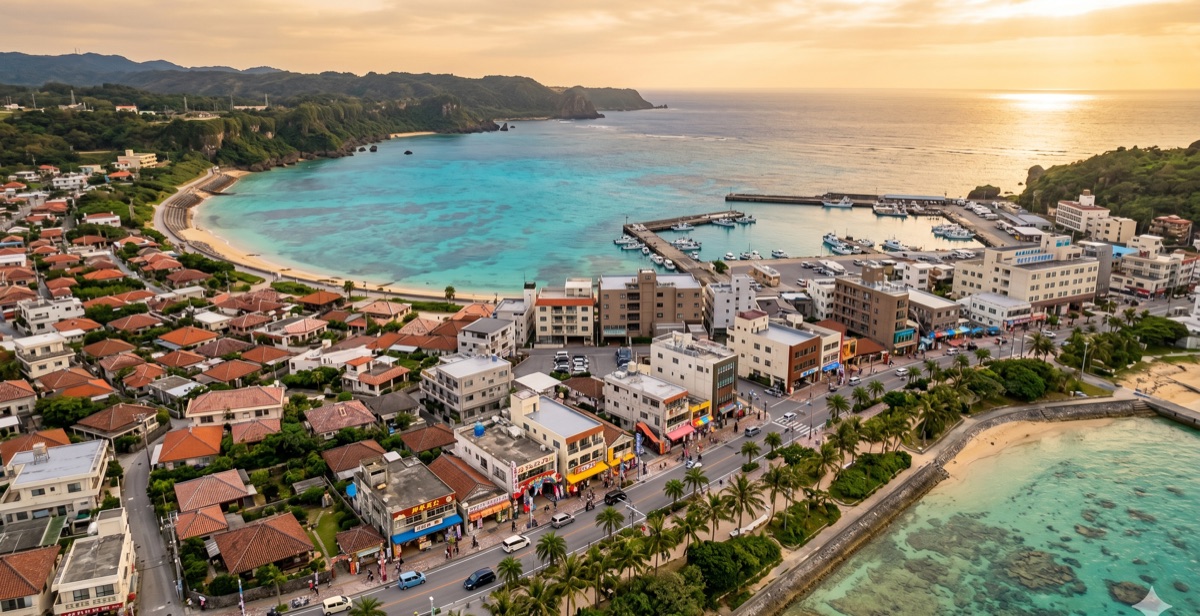
The question nobody asks first
Most people research Okinawa neighborhoods by asking "which is the best?" The better question is: best for whom? A retired couple who want peace and ocean views have completely different needs than a young professional who wants to walk to restaurants and avoid a car payment. And a military family arriving on SOFA status is navigating a different set of constraints than a freelancer on a digital nomad visa.
Okinawa's main island stretches about 130km from tip to tip. The areas where most expats live cluster in the central third — roughly from Naha in the south up through Ginowan, Chatan, Okinawa City, and Kadena. North of that is gorgeous and affordable but genuinely remote. South of Naha is largely residential and Japanese-speaking.
Here's a quick matcher before we go deep on each area:
At a glance: rent and lifestyle
| Area | 2LDK Rent / month | English access | Car needed? | Best for |
|---|---|---|---|---|
| Chatan / Sunabe | ¥90,000–¥130,000 | Excellent | Optional | Expat community, beach lifestyle |
| Ginowan | ¥75,000–¥120,000 | Good | Yes | Families, professionals |
| Naha | ¥70,000–¥110,000 | Moderate | No | Urban lifestyle, transit users |
| Yomitan / Kadena Town | ¥55,000–¥95,000 | Moderate | Yes | Families wanting space, base proximity |
| Okinawa City (Koza) | ¥45,000–¥80,000 | Fair | Yes | Budget, cultural immersion |
| Onna Village | ¥50,000–¥90,000 | Low | Essential | Remote workers, retirees, divers |
| Urasoe / Nishihara | ¥55,000–¥90,000 | Fair | Yes | Naha-adjacent, quieter, good value |
| Uruma City | ¥40,000–¥75,000 | Low | Essential | Budget, long-term locals |
On rent in expat areas: Military demand inflates rents in Chatan, Ginowan, and the Kadena corridor. Local landlords know that SOFA-status families receive housing allowances, and prices reflect it. If you're a civilian foreigner negotiating directly, push back — especially on older properties. Rents for Japanese tenants in the same buildings are often 15–25% lower.
The neighborhoods
Chatan has held the #1 spot in Okinawa's livability rankings — Daito Kentaku's "Machi no Sumigokochi" ranking — for seven consecutive years (most recently published August 2025 by the Okinawa Times). If you're moving to Okinawa and don't know where to start, most people start here — and many never leave.
The Sunabe seawall is the social spine of the area: a long stretch of road lined with dive shops, surf bars, English-menu cafés, and restaurants from a dozen countries. On any given evening you'll find expats, local Okinawans, and day-trippers sharing the space. American Village, a shopping and entertainment complex built on reclaimed US military land, adds a surreal American-mall-in-Japan experience that's oddly charming rather than grating.
English is genuinely functional here. Many restaurants have English menus, staff at most shops are accustomed to non-Japanese speakers, and multiple dive shops, gyms, and services are run by or specifically catering to foreigners. For a newly arrived expat, the cognitive load of daily life in Chatan is meaningfully lower than anywhere else on the island.
The honest tradeoff: Rent is the highest on the island. A decent 2LDK near the seawall runs ¥100,000–¥130,000 — considerably more than comparable space in Ginowan or Yomitan. Walking-distance to American Village climbs higher still: 2LDK units within a few minutes' walk of Mihama typically list at ¥150,000–¥210,000 on local agency sites. The summer crowds around American Village can be relentless. And if you want a deeply Japanese experience, Chatan's heavy Americanization means you'll need to drive further for it.
- Best expat community infrastructure on the island
- Walking distance to beaches, dive sites, restaurants
- English everywhere — lowest daily language barrier
- Active social scene; easy to meet people
- Close to central Okinawa (Kadena, Ginowan, Naha all within 20 min)
- Araha Beach and Sunset Beach are beautiful and free
- Highest rents on the island
- Busy and touristy in summer; American Village gets crowded
- Limited authentic Japanese daily-life experience
- Route 58 traffic can be brutal at rush hour
- Few large supermarkets; mostly smaller convenience stores nearby
Ginowan is where a lot of expats end up after their first year — the ones who started in Chatan, realized they needed more space and quieter streets, and didn't want to sacrifice convenience. It's the pragmatic choice, and there's nothing wrong with that.
Geographically, Ginowan sits almost exactly in the center of the island, equidistant from Naha and Chatan. That central positioning makes it one of the most practical bases for daily life: the University of the Ryukyus Hospital is here, Parco City shopping is nearby, and the drive to virtually anywhere on the main island is reasonable. It's also adjacent to Futenma Air Station, which means some aircraft noise depending on your exact location — worth checking before signing a lease.
The expat community here is real but quieter than Chatan's. Many long-term civilian families, university staff, and professionals choose Ginowan for its schools and stability. The neighborhood has a genuinely residential feel — this is where people build a life, not just a posting.
- Central location — everything on the island is within reach
- Quieter and more spacious than Chatan
- Good international schools nearby
- University of the Ryukyus Hospital in the area
- Solid English-capable services without the tourist markup
- Slightly lower rents than Chatan for equivalent space
- Aircraft noise from Futenma in some areas
- Less nightlife and social scene than Chatan
- No beach access — need to drive
- Car is essential; no rail or reliable bus network
- Route 58 traffic is shared with Chatan commuters
Naha is the only city in Okinawa where you can credibly live without a car. The Yui Rail monorail connects Naha Airport to the city center and extends north to Urasoe, making it the most transit-accessible part of the prefecture. For anyone coming from a major city and resistant to buying a vehicle, Naha is the answer.
The city has a different energy than the expat corridor to the north. It's more Japanese, more dense, more urban. Kokusai-dori (International Street) is touristy but surrounded by genuinely excellent local food, independent shops, and a thriving restaurant scene. Shuri, with its castle and surrounding neighborhoods, offers some of the most characterful residential streets in Okinawa. The government district employs a significant professional population, which shapes the city's daytime tempo.
The expat community in Naha is smaller and less connected than in Chatan — you'll encounter fewer English-first services and more situations requiring Japanese. But for expats who are serious about language acquisition or who want a deeper immersion in Okinawan culture, this is actually a feature rather than a bug.
- Only area where you can live without a car
- Best food scene on the island — local and international
- Culturally rich: Shuri Castle, traditional markets, live music
- International airport proximity
- Government and corporate job concentration
- Slightly lower rents than Chatan for urban living
- Farthest from the central expat community (Chatan is 30+ min)
- Less English-language service infrastructure
- Parking is scarce and expensive
- No beach — nearest good beach requires a drive
- Monorail is limited; buses needed for most destinations
- Dense and urban — not for those wanting space or quiet
North of Chatan, the landscape opens up. Yomitan is one of Okinawa's most distinctive villages — famous for Ryukyuan pottery (yachimun), traditional weaving (bingata), and some of the best beaches on the island including Zanpa Cape and Nirai Beach. It has a cultural depth that the central expat corridor often lacks.
Kadena Town immediately surrounds Kadena Air Base and draws many military families and base workers who want a short commute. The town itself is relatively compact but has essential services. Many families here access the base's commissary, BX, and recreational facilities, which effectively lowers the cost of living if you have access rights.
Both areas are quieter and more residential than Chatan. For families with children who want space — a yard, room to breathe, a slower pace — Yomitan in particular delivers that in a way the central corridor simply can't. Daily errands require Japanese or a translation app, and English-only services are sparse, but that's part of the appeal for families committing to real integration.
- More space for the money — houses with yards are findable
- Beautiful beaches without Chatan's crowds
- Strong Ryukyuan cultural character
- Quieter, more peaceful daily rhythm
- Good proximity to Kadena Air Base
- Lower rents than central expat areas
- Fewer English-language services
- Longer drive to Naha and south Okinawa
- Limited dining and entertainment options locally
- Car is absolutely essential
- Smaller expat community — social scene requires more effort
Koza doesn't look like anywhere else in Japan. The neighborhood grew up around Kadena Air Base during the postwar American administration of Okinawa, and its character still reflects that hybrid history — hand-painted signs mixing English and Japanese, music venues playing everything from Okinawan sanshin to heavy metal, gritty covered shopping arcades, and a multicultural population that never quite blended into the mainland Japanese mainstream.
It's the cheapest of the main expat-adjacent areas, and the apartments reflect the neighborhood's age — you'll find large, affordable spaces in older concrete buildings that feel nothing like the polished new-builds of Chatan. For musicians, artists, or anyone who wants to feel like they live in a real place rather than an expat enclave, Koza is compelling.
The honest challenge is English access. Fewer restaurants and services cater to non-Japanese speakers here, and daily life requires more Japanese than in Chatan or Ginowan. But the payoff is a genuine local experience and rents that make Chatan look almost absurd by comparison.
- Most affordable rents in an expat-adjacent area
- Genuinely unique cultural character — unlike anywhere else in Japan
- Strong live music and arts scene
- Diverse, non-homogeneous community
- Close to Kadena Air Base
- Excellent local food at local prices
- Very limited English services
- Older building stock — choose apartments carefully
- Car essential for most errands
- Less polished infrastructure than Chatan/Ginowan
- Farther from the main expat social scene
The west coast north of Chatan is the most scenic stretch of Okinawa's main island. Onna Village sits in the middle of it — luxury resorts, coral reefs accessible from the shore, whale shark dives at the Churaumi Aquarium nearby, and an unhurried pace that feels more like island resort living than suburban Japan.
For remote workers who don't need to commute, retirees who prioritize beauty over convenience, and serious divers who want to roll out of bed and into the water, Onna delivers something rare. Rents can actually be reasonable for the scenery — a standard apartment in the village interior costs less here than a standard apartment in Chatan. The catch: the listings you'll see first on aggregator sites lean heavily toward resort villas and ocean-view properties around Cape Manza and Tiger Beach, which can easily list at ¥200,000–¥300,000/month. Filter for ordinary residential apartments away from the coast and the picture changes considerably.
But the isolation is real. A basic supermarket, the nearest proper hospital, Naha for an appointment — all of these require a 30–45 minute drive. If anything goes wrong with your car, your day unravels. The north is not a neighborhood for anyone who needs the city regularly. It's a commitment to a specific way of life, and the people who love it tend to love it intensely.
- The most beautiful stretch of Okinawa's coastline
- World-class diving and snorkeling from shore
- Peaceful, genuinely slow pace of life
- Ocean views at lower-than-Chatan rents
- Strong community among the expats who choose to live here
- Churaumi Aquarium, Nago, and northern nature all accessible
- Genuinely remote — everything requires a drive
- Very few English-language services
- Job options are nearly zero outside tourism and hospitality
- Car is not optional — it's your lifeline
- Nearest major hospital is 30+ minutes away
- Social isolation is a real risk without intentional community-building
Urasoe and Nishihara sit immediately north and east of Naha respectively, offering the capital's convenience without its density and price. The Yui Rail's northern terminus — Tedako-Uranishi (てだこ浦西) — is in western Urasoe, opened in October 2019 as part of the 4-station extension from Shuri. The station sat surrounded by empty fields for years, but development has accelerated: a new Aeon Style "Tedako-Uranishi Ekimae" shopping center opened on the station rotary in September 2025, and a 992-car park-and-ride lot at the station means commuters from Yomitan, Kadena, and central Okinawa can drive to the station and rail into Naha. Nishihara is home to the University of the Ryukyus main campus and has a predictable student-and-academic community feel.
These are quieter residential neighborhoods — not glamorous, not particularly characterful, but solid and practical. Families who work in Naha but want more space, or academics associated with the university, tend to choose here. Rents are meaningfully lower than comparable space in Chatan while still being close enough to Naha that a car is useful rather than essential.
- Proximity to Naha without Naha prices or density
- Monorail access at Urasoe's northern terminus
- University community in Nishihara
- Good hospitals and schools nearby
- Quieter residential character
- Limited character — functional rather than interesting
- Far from the central expat community
- Limited English services outside university areas
- No beach access
Practical tips for choosing
Visit before committing. If at all possible, spend a week in two or three different areas before signing a lease. What sounds ideal in a guide feels different when you're driving it at 8am with nowhere to park.
Your commute determines everything. Okinawa has no rush-hour escape valve — the roads congest badly on Route 58 and around Naha during peak hours. If you're commuting to a base, a school, or an office, run that commute at the time you'd actually do it before choosing a neighborhood.
Older buildings offer far more space. A ¥60,000/month apartment in Koza or Uruma will be significantly larger than a ¥100,000/month unit in a new Chatan building. If square footage matters to you, look at older stock outside the premium areas.
English access degrades quickly outside the corridor. The Chatan–Ginowan–Kadena strip has by far the best English-language infrastructure. Every step north or south, or east toward the center of the island, reduces that meaningfully. Budget for this reality: you'll need more Japanese ability, or more patience with translation apps, outside the main corridor.
Your first neighborhood won't be your last. Most long-term expats in Okinawa move at least once. A common arc: arrive in Chatan, love it, then move to Ginowan or Yomitan when they start a family or want to reduce rent. Starting in the expat hub makes sense — you'll build your bearings and your network quickly, and you can always move later with better information.
Frequently asked questions
Sources & further reading
- 沖縄タイムス — 沖縄で本当に住みやすい街ランキング2025 (北谷町 7年連続1位)
- アットホーム タウンライブラリー — 沖縄県内で住みやすい街ランキング2025
- クレバリーホーム沖縄 — 沖縄の住みやすい街ランキング (2025最新版)
- 中部興産 — 沖縄の家賃は高い?地域ごとの家賃相場 (2026)
- 中部興産 — 沖縄の住みやすい地域とおすすめの街
- SUUMO — 沖縄県の賃貸家賃相場 (by municipality)
- Yahoo!不動産 — 沖縄県の家賃相場ランキング
- うちなーらいふ — 北谷町の賃貸アパート・マンション
- うちなーらいふ — 恩納村の賃貸アパート・マンション
- うちなーらいふ — 読谷村の賃貸アパート・マンション
- 乗りものニュース — ゆいレール延伸5年: てだこ浦西駅周辺の変化 (2024)
- 浦添市 — モノレール浦添延長開業
- ラビタル — 地域別で見る沖縄の人気エリアランキング