The short answer
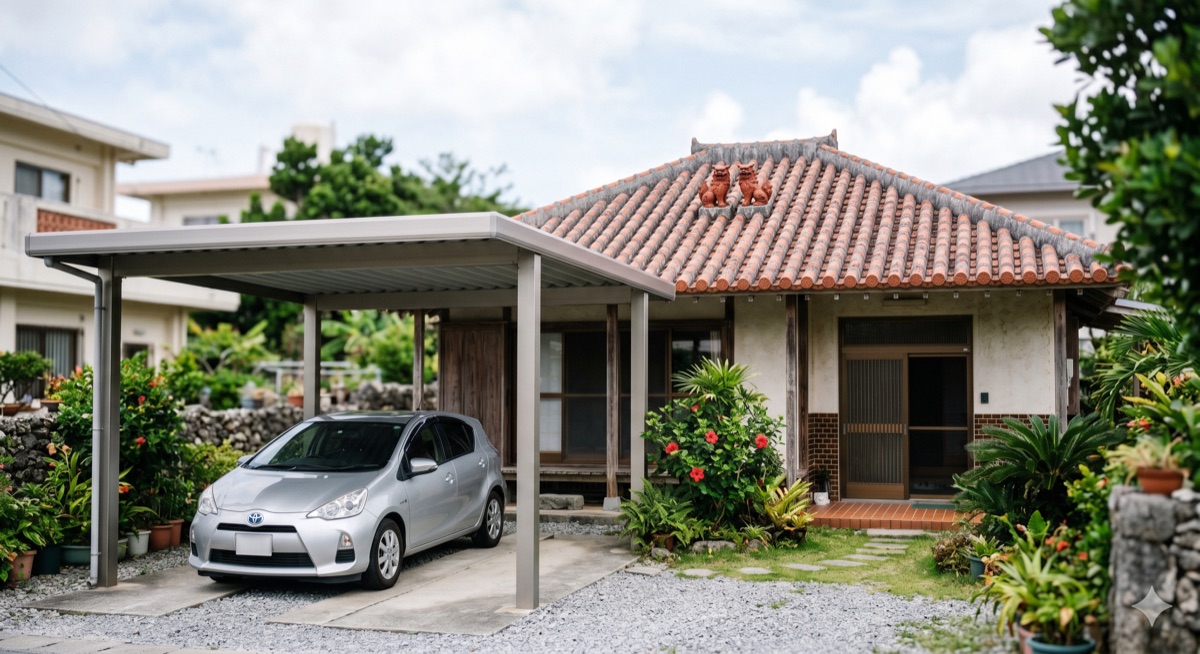
Garages are rare in Okinawa for three reasons that compound: land is expensive and tightly regulated, enclosed garages are taxed as building floor area while open carports usually aren't, and typhoons reward simple structures with nothing to peel off. The result is the standard Okinawa setup — a flat concrete pad, four aluminum posts, and a polycarbonate roof — repeated in front of almost every detached house on the island.
If you're buying a house without one, adding a carport here is more expensive than mainland Japan — usually ¥400,000 to ¥1,000,000 (~$2,700–$6,700) installed for a single bay — because Okinawa's prefectural basic wind speed is 46 m/s (≈103 mph), the highest in Japan, and reinforced typhoon-spec frames cost meaningfully more than mainland-standard ones. If you're buying a car here, you'll need to deal with the carport question before you can even register the vehicle.
Why this matters before you buy a house: Japan's proof-of-parking rule applies in every major Okinawa city — Naha, Okinawa City, Urasoe, Ginowan, Tomigusuku, Uruma, Itoman, and Nago all require a shako shōmeisho before you can register a regular passenger car. If a house has no carport pad and no obvious place to add one — and you can't lease a nearby lot — you legally cannot keep a regular car there. Kei cars (yellow plate, 660cc) have a softer version of the rule, which is part of why they dominate Okinawa.
Why Okinawa houses skip the garage
Garages count as taxable building space
In Japanese property law, a fully enclosed garage attached to a house is treated as part of the building. It counts toward your fixed asset tax assessment, your floor-area ratio (容積率, yōsekiritsu), and depending on how it's enclosed, your building coverage ratio (建蔽率, kenpeiritsu) as well. An open carport with two posts and a roof is treated as an exterior structure — like a fence or a garden shed — and falls outside the building envelope for most tax and zoning purposes.
Translating that into numbers: a 20㎡ enclosed garage on a typical Okinawa lot can add ¥40,000–¥80,000 to your annual fixed asset and city planning tax bill. Multiplied over 30 years of ownership, that's enough to buy several carports.
Land is tight and zoning is unforgiving
Most residential zones in Okinawa cap building coverage at 50–60% of the lot. A 165㎡ (50 tsubo) lot with a 60% coverage ratio gives you 99㎡ of allowable building footprint — and you want most of that for living space, not parked cars. A carport eats no footprint from that allowance; a garage eats a lot of it.
Typhoons reward structures that don't have much to break
Okinawa sits in one of the most active typhoon corridors in the Pacific. The prefecture's official basic wind speed under the Building Standards Act is 46 m/s (~103 mph / 166 km/h) — the highest of any prefecture in Japan, set by the Ministry of Land, Infrastructure, Transport and Tourism specifically because of the typhoon exposure. A typical year brings 2–4 named storms across the islands, and a direct hit can deliver sustained winds well into that range with gusts above. Garage doors are a known weak point: when a roll-up door fails in a typhoon, the pressure differential can lift the roof clean off. A four-post carport with a polycarbonate roof has almost nothing to fail in that way. The roof panels are designed to pop out in extreme winds, leaving the frame and the car beneath intact.
This is also why Okinawa carports almost always have posts on both sides (両側支持, four-post) even for single-car installs. The mainland default — a two-post cantilever where the roof extends from a single line of posts on one side — is much more vulnerable to twisting forces in a typhoon. The 4-post layout costs more but is what every reputable Okinawa installer will quote first for a typhoon-spec setup. The top-tier 62 m/s models (YKK G-Port Pro) go further still — 6 posts for a 1–2 car bay, 8 posts for a 3-car bay.
And the climate doesn't punish open parking
Okinawa rarely freezes. Snow is not a factor. The only weather problems for a car parked outside are sun (UV damage to paint and interior), salt-laden air, and the occasional flying coconut. A roof solves the first; nothing short of an enclosed bay solves the second, and locals have largely decided the second isn't worth ¥3M and a tax hit.
Proof of parking: the rule that drives everything
Japan's 1962 Garage Act (車庫法) requires that every regular passenger vehicle have a designated, legal parking spot registered with the police before it can be put on the road. The document is called the shako shōmeisho (車庫証明書) — literally "garage certificate." Without it, you cannot register a car at the Land Transport Office.
What qualifies as a parking spot
- Within 2 km of your registered address. Measured as a straight line, not driving distance.
- Large enough to fit the vehicle completely. No part of the car can protrude onto a public road. The police will measure when they inspect.
- Owned, leased, or with written permission to use. Ownership is not required. A standard month-to-month lease for a nearby coin-parking spot or private lot is sufficient as long as you have the paperwork.
- A flat carport pad counts. Concrete, gravel, or even a clearly marked patch of dirt is fine as long as the dimensions check out.
The Okinawa-specific kei car situation
Kei cars — the 660cc class with yellow license plates — are exempt from the pre-registration requirement nationally. In most of Japan you still have to file a simpler "Storage Location Notification" (保管場所届出, hokanbasho todokede) within 15 days. In Okinawa, this notification requirement only applies in Naha City and Okinawa City — everywhere else on the main island, kei car owners don't need to file anything. This is part of why kei cars are dominant here: in much of the prefecture there is genuinely zero parking paperwork attached to ownership.
The fee for a regular-car shako shōmei application in Okinawa is ¥2,200, paid at the police station with jurisdiction over your parking location. The police conduct an on-site inspection within 3–7 days.
Before you buy a house, look at the parking: If the property is in a shako-shōmei city (most of central and southern Okinawa) and has no carport pad and no obvious place to add one, ask the agent specifically about parking eligibility. Some older properties on narrow lanes physically cannot fit a standard car. Some neighborhoods have no nearby coin parking. This is a deal-breaker hiding in plain sight.
Carport vs. garage: the actual tradeoff
For most Okinawa homeowners, the math is one-sided. But here's the honest comparison:
| Factor | Carport | Enclosed garage |
|---|---|---|
| Install cost (1 car, Okinawa-spec) | ¥400K–¥1M | ¥2M–¥4M+ |
| Counts toward FAR/BCR | Usually no | Yes |
| Adds to fixed asset tax | No | Yes |
| Typhoon vulnerability | Roof panels may pop | Door is the failure point |
| Protects from salt air | Partial | Good |
| Build permit (確認申請) | Often required if >10㎡ | Always required |
| Resale appeal | Expected baseline | Premium feature, limited buyer pool |
A few car-enthusiast owners do build proper garages — usually integrated into the house at the design stage as a "garage house" (ガレージハウス). It's an architectural choice, not a practical one.
What wind rating you actually need
This is the part most generic carport guides get wrong for Okinawa. Standard mainland Japan carports are rated for 38 m/s winds (~137 km/h). That's adequate for most of Honshu and fine for typical Okinawan weather — but Okinawa's prefectural basic wind speed is set at 46 m/s, and a strong typhoon can blow past even that. Buying anything rated below 46 m/s here is a known mistake.
The three main rating tiers
- 38 m/s standard — the entry-level rating on most LIXIL and YKK AP models. Fine for inland mainland; do not buy this in Okinawa unless you're prepared to dismantle the roof before every typhoon.
- 46 m/s reinforced ("Okinawa-spec") — the practical baseline that matches the prefecture's official wind standard. The bestseller at Okinawa branches is the Sankyo Tateyama "Bronia α 1500" with vinyl frame, rated to 46 m/s. LIXIL and YKK AP both offer equivalent lineups. This is what most reputable installers will quote first.
- 54–62 m/s heavy-duty — the top tier. YKK AP "Leon Port Neo GR" goes up to 62 m/s with a six-column reinforced frame. YKK AP "G-Port Pro GR 3000" uses a steel folded-plate roof rated up to 62 m/s — the strongest residential carport on the market. Right choice for exposed coastal or hilltop properties, and increasingly the default for new builds in northern Okinawa.
Even 62 m/s is not a guarantee against a Cat 4–5 direct hit. In practice, every carport in Okinawa is a calculated bet: a 46 m/s model will survive 95% of storms, and in the worst hit you accept that the polycarbonate roof panels might detach. The frame should remain standing, and a roof panel costs ¥10,000–¥30,000 to replace.
Aluminum vs. steel — and the salt air problem
Almost all residential carports in Okinawa use aluminum frames. The reason is simple: salt-laden coastal air corrodes carbon steel quickly, and Okinawa is never more than a few kilometers from open sea. Aluminum forms a protective oxide layer that resists corrosion almost indefinitely. The tradeoff is that aluminum is lighter, which means in extreme wind events it's the anchoring and roof clipping that matters more than the metal itself.
Galvanized or powder-coated steel can be used inland in mainland Japan; in Okinawa, you'll see it almost exclusively on commercial structures, not residential carports.
Building code: what's allowed
Two regulations matter for adding a carport:
Building permit (建築確認申請)
A formal build permit is technically required for any roofed structure larger than 10㎡ with a roof and supporting columns, even an open-sided carport. In practice, enforcement varies widely across Okinawan municipalities. A reputable installer will pull the permit; many smaller installers do not. The cost of the permit application is ¥30,000–¥80,000 if your installer handles it; the inspection adds 2–4 weeks to the timeline.
Coverage ratio relief
Open-sided carports on residential lots qualify for a special exemption: only the area exceeding 1 meter of overhang from the structure counts toward your building coverage ratio. For a standard 2.7m × 5.4m single-bay carport (14.6㎡), only about 5㎡ effectively counts against your BCR — and many municipalities waive even that for compliant residential carports. Check with the local kenchikushi (建築士) or municipal building office before you order.
Existing structures are easier than new ones: If the property you're buying already has a carport (even an old one), you almost never need to deal with permit paperwork unless you replace or expand it. Many Okinawa houses have carports that pre-date current rules and are simply grandfathered in.
What it costs to install
Prices below are for residential aluminum carports installed in Okinawa as of early 2026. They include the structure, basic concrete pad work, and standard installation. They do not include permit fees, demolition of existing structures, or electrical work (lighting, EV charger).
| Configuration | Wind rating | Installed cost |
|---|---|---|
| 1 car, aluminum formed roof | 46 m/s | ¥548K~ |
| 1 car, steel galvanized | 54+ m/s | ¥700K~ |
| 1 car, heavy-duty steel folded-plate | 62 m/s | ¥800K–¥1.1M |
| 2 car, aluminum side-by-side | 46 m/s | ¥600K–¥800K~ |
| 2 car, formed aluminum | 46 m/s | ¥768K~ |
| 2 car, steel custom-shape | 54+ m/s | ¥1.59M~ |
| 3 car, aluminum | 46 m/s | ¥900K~ |
| Concrete pad only (no roof) | — | ¥80K–¥200K |
| Typical Okinawa homeowner choice (1 car, 46 m/s) | ¥550K–¥800K | |
Prices from real Okinawa installer quote ranges (ienakama.com, Reform Doctor Okinawa) as of early 2026. The "~" suffix indicates a starting price. Variation between installers is 20–30%; getting 2–3 quotes is normal. Most reputable installers — ちゅらら工房, エコアイランド沖縄, 沖縄エクステリア, イチコウ, インストール沖縄, 七色, 喜神サービス — will give a same-day estimate from a site visit.
The install process, step by step
From "I want a carport" to "the car is parked under it" is typically 4–8 weeks, mostly limited by material lead time. Here's the sequence:
-
Site visit and quote
The installer measures your lot, checks soil and slope, confirms there's road access for a small concrete mixer, and discusses orientation. Most reputable installers (LIXIL, YKK AP authorized dealers, large home centers like Makeman and Cainz) quote on the spot. Get 2–3 quotes.
-
Choose the model and roof
Decide on the wind rating, frame color (most pick bronze or dark gray), and roof type. Polycarbonate is standard; heat-blocking polycarbonate adds ¥30K–¥80K and noticeably reduces interior car temperatures. Aluminum slat or pebble-finish roofs cost more but never need panel replacement after storms.
-
Permit application (if required)
For structures over 10㎡, your installer files the building permit with the municipal office. This adds 2–4 weeks. Smaller carports often skip this step.
-
Pad work
If you don't already have a concrete pad, the installer pours one. This is a one-day job followed by 3–5 days of curing time before any frame load. Existing pads are inspected for cracks and level.
-
Frame and roof install
The actual carport goes up in a single day — usually 4–6 hours for a single-bay unit with two installers. Roof panels go on last after final adjustments.
-
Shako shōmei filing (if buying a car)
Once the carport is built, you can use it as your registered parking spot. The Okinawa Prefectural Police handle the paperwork at the station with jurisdiction over your parking address: a ¥2,200 application fee, 3–7 days for an on-site inspection, and then the certificate is issued. This is a separate process from the install itself.
Frequently asked questions
Sources & further reading
- 沖縄県警察 — 自動車保管場所(車庫)証明手続き (Okinawa Prefectural Police — official shako shōmei procedure)
- くるなび — 沖縄県 車庫証明が必要な地域一覧 (Okinawa municipalities where shako shōmei is required)
- くるなび — 沖縄県 軽自動車の車庫届出が必要な地域 (Kei car notification regions in Okinawa)
- 家仲間コム — 沖縄県 カーポート設置・工事の価格相場 (Okinawa carport installer price ranges)
- リフォームドクター — 沖縄県のカーポートおすすめ業者10選 (Top 10 Okinawa carport installers, Jan 2026)
- 沖縄タイムス住まい — 愛車を守るカーポート (Okinawa Times — choosing a carport for Okinawa)
- かふう — 沖縄仕様の建材・エクステリアと台風対策 (Okinawa-spec building materials and typhoon countermeasures)
- 三協アルミ — 強風に備える|カーポート選びのポイント (Sankyo Aluminum — wind-resistant carport selection)
- YKK AP — カーポート 確認申請書類 (carport building permit documents)
- Japan Property Central — Building Regulations in Japan
- Parking Reform Atlas — Japan's Proof-of-Parking Rule